Why this works

Your disc, explained

The reasoning behind every block in your return program.

L4-L5 herniation · sagittal view

A pressure problem, not a damage problem.
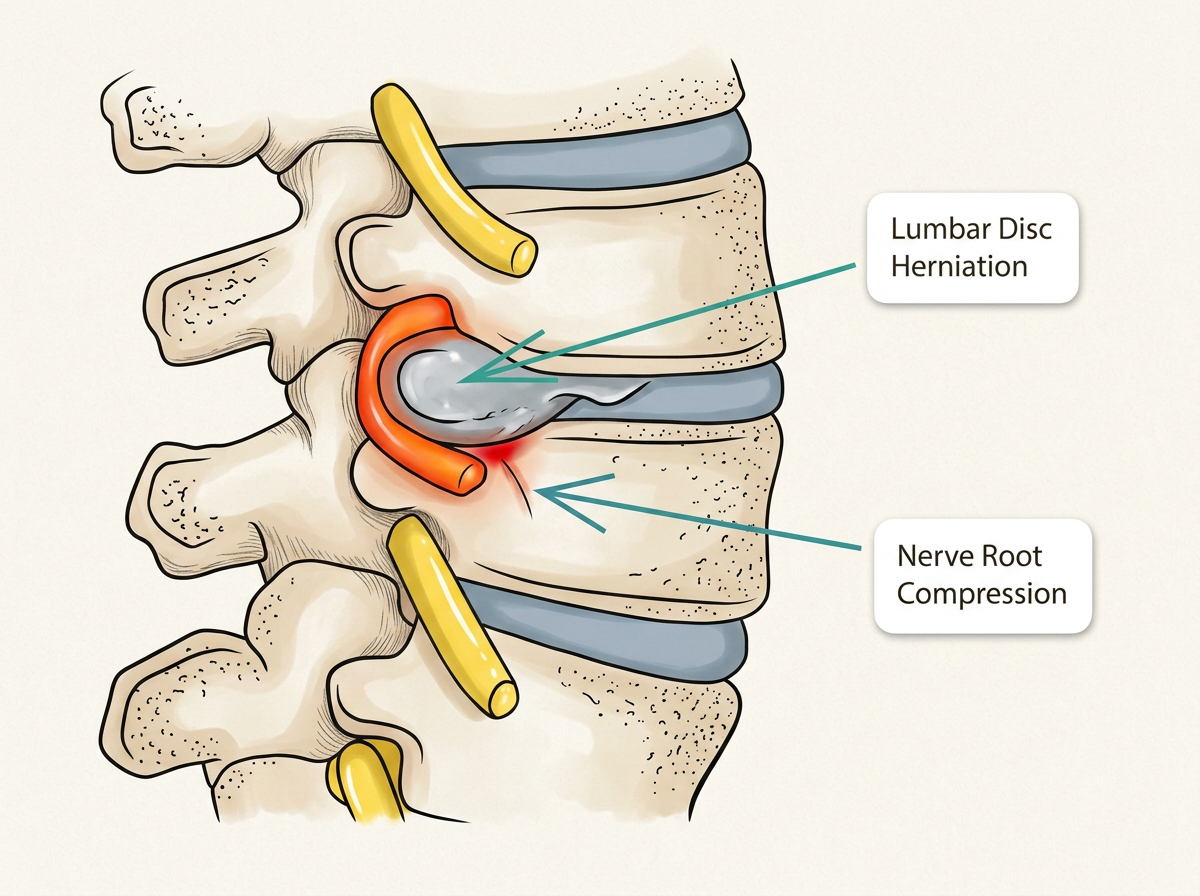
Hand-drawn medical illustration of the lumbar spine in side view, showing four vertebrae with yellow nerve roots, blue-gray discs, and one herniated disc as an orange-red inflamed ring around extruded gray disc material pressing on a nerve root. Two labels point to 'Lumbar Disc Herniation' and 'Nerve Root Compression'.
The nucleus is wrapped by the annulus rings. A posterior bulge presses on the nerve root - pain comes from pressure & inflammation, not fragility.

The fix is to offload the disc with a stronger core and stronger hips, while restoring gentle motion that pushes the disc back to center.

How your program targets the injury

Deep core (dead bug, bird dog)

Builds the internal pressure system that braces your spine - a trained deep core meaningfully reduces the load your disc carries with every step.

Glute strength (bridges)

Hips do the heavy lifting so the lumbar spine doesn't have to. One of the strongest protective factors against re-injury.

Hip mobility (90/90)

Stiff hips force the low back to compensate. Restoring rotation removes a daily aggravator.

McKenzie extension

Low-grade extension nudges the disc nucleus back toward center, away from the nerve.

Rules of thumb for pain

  • Green (0-2): push within target strain.
  • Yellow (3-5): we modify - same blocks, slower tempo, less load.
  • Red (6+): decompression + walking only. Loaded work is paused.
  • Leg pain easing into the back? Good - that's centralization.

Library

The thesis

Rehab is training, not a timeout.

Fitness apps treat injury as missing data. Rehab tools are blind to training load. Rebound is the return mode they're both missing - progression you earn, load that's governed, and a finish line your wearable already measured: your baseline.

Educational demo - not medical advice.